
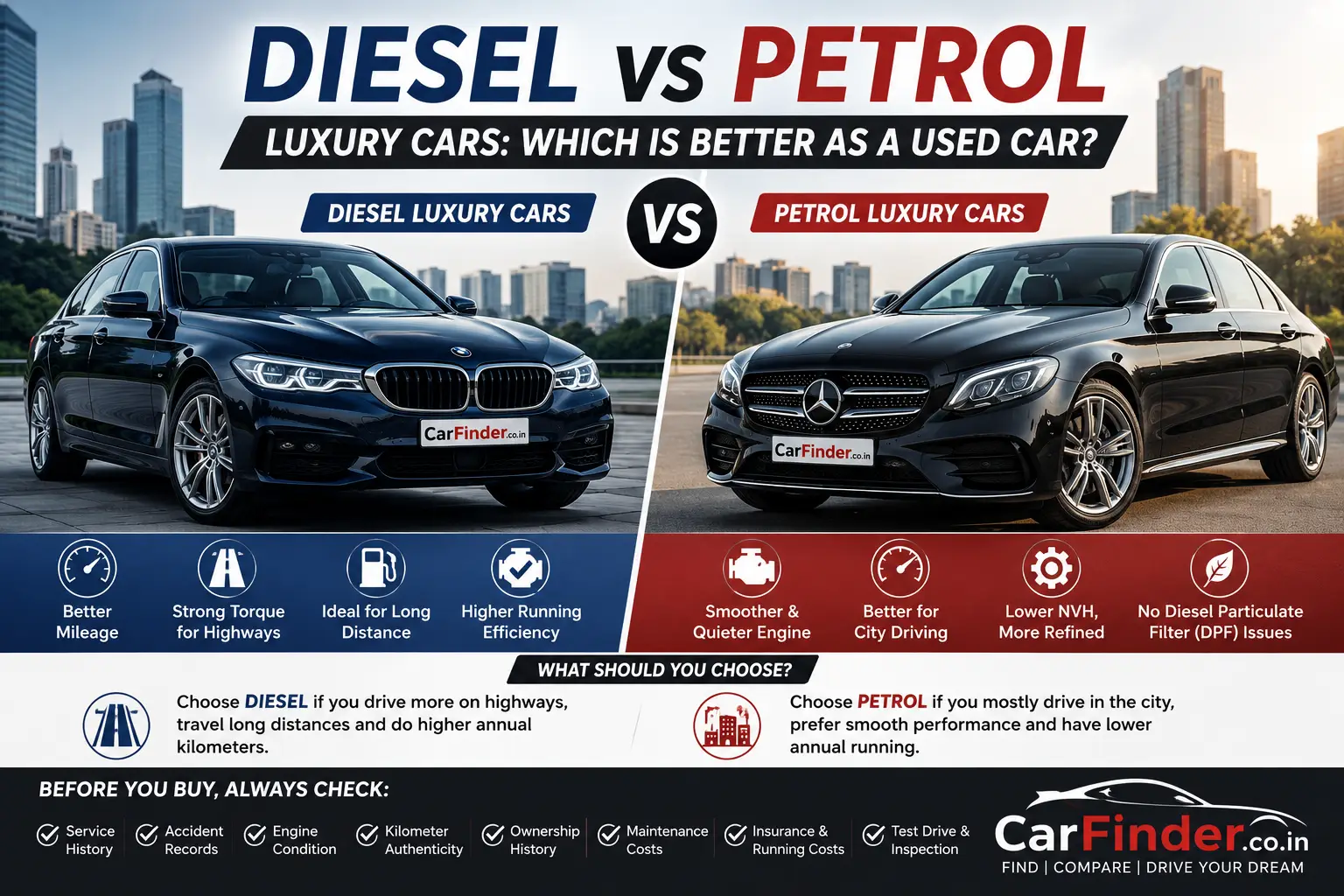
Buying a used luxury car can give you access to premium comfort, powerful engines and advanced features at a much lower price than a new model. But one important question remains: Should you choose a petrol or diesel luxury car?
Both fuel types have their advantages and disadvantages. The right choice depends on your driving habits, maintenance budget and how long you plan to keep the car.
Petrol Luxury Cars: Smooth and Refined
Petrol engines are generally known for their smooth and quiet performance. This makes them particularly attractive in luxury cars, where refinement and comfort are major priorities.
Advantages of Petrol Luxury Cars
Smoother and quieter engine operation
Quick and responsive acceleration
Better suited for mostly city driving
No diesel-specific emissions-system concerns
Often more enjoyable for performance-oriented buyers
However, petrol luxury cars can consume more fuel, especially when driven frequently in heavy traffic.
Diesel Luxury Cars: Better for Long-Distance Driving
Diesel engines are popular among buyers who regularly travel long distances. They typically offer strong low-end torque and better fuel efficiency, depending on the model and driving conditions.
Advantages of Diesel Luxury Cars
Strong torque for highway driving
Generally better fuel economy
Suitable for frequent long-distance travel
Can be a good choice for high annual mileage
Diesel models, however, may have additional emissions-related components that can become expensive to repair as the vehicle gets older.
Maintenance: What Should You Expect?
Maintenance is particularly important when buying a used luxury car. A diesel model may have components such as a diesel particulate filter and other emissions-control systems that require attention.
Petrol cars can also have expensive repairs, particularly when equipped with turbochargers, direct injection and advanced electronic systems.
Therefore, service history is more important than simply choosing petrol or diesel.
City Driving vs Highway Driving
Your daily driving pattern should play a major role in your decision.
Mostly city driving: A petrol luxury car can be the simpler choice, especially if your daily running is relatively low.
Frequent highway driving: A diesel luxury car may make more sense because of its strong torque and potentially better fuel economy.
What About Resale Value?
Resale value depends on the specific brand, model, age, condition, mileage and local demand. Fuel type alone does not determine how much a luxury car will be worth.
A well-maintained luxury car with complete service records can be easier to sell than a poorly maintained vehicle, regardless of whether it has a petrol or diesel engine.
Check These Things Before Buying
Before purchasing a used petrol or diesel luxury car, inspect:
Complete service history
Accident and insurance records
Engine and transmission condition
Odometer authenticity
Turbocharger condition, if equipped
DPF and emissions system on diesel models
Cooling system
Suspension and brakes
Tyres
Electrical and infotainment systems
Existing warning lights
A professional pre-purchase inspection can help identify expensive problems before you complete the deal.
Petrol or Diesel: Which One Should You Buy?
There is no single answer for every buyer.
Choose a petrol luxury car if you want smooth performance, mostly drive in the city and have relatively low annual running.
Choose a diesel luxury car if you regularly travel long distances, drive significant kilometres every year and value strong torque and fuel efficiency.
Final Verdict
When buying a used luxury car, don't choose purely on the basis of petrol or diesel. Consider the specific model, maintenance history, mileage, ownership cost and overall condition.
A well-maintained diesel BMW, Mercedes-Benz or Audi can be a better purchase than a neglected petrol car—and the same is true in reverse.
The smartest approach is to compare multiple cars, inspect their history and calculate the expected ownership cost before making your final decision.
Find and compare used cars on CarFinder.co.in and choose the car that fits your budget and driving needs.
